
Operational Governance Infrastructure
Governance Infrastructure Model
GIAOIR™: Operational governance infrastructure for how intelligence becomes action
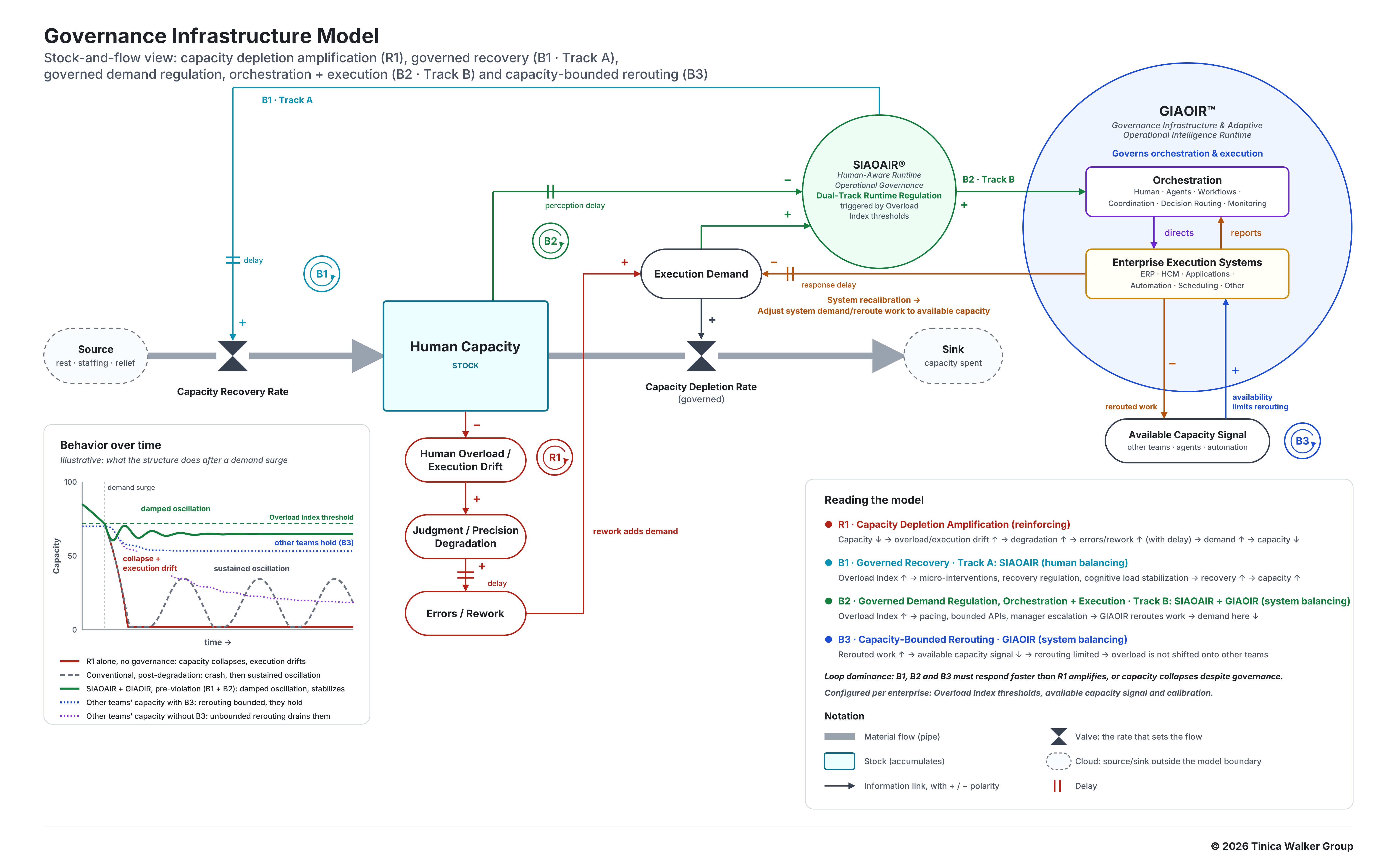
One reinforcing loop. Three governance loops. Grounded in systems thinking.
GIAOIR™ (Governance Infrastructure & Adaptive Operational Intelligence Runtime) is a closed-loop operational governance architecture embedded in AI orchestration and enterprise execution systems. Orchestration directs execution, and execution reports back. Within that loop, GIAOIR™ governs how intelligence becomes authorized decisions, coordinated actions and adaptive operational outcomes across humans, agents and workflows.
Execution has one constraint that orchestration can’t see on its own: human capacity.
SIAOAIR® (Human-Aware Runtime Operational Governance) makes GIAOIR™ human-aware. The two systems operate independently. Together, they close every loop.
The model is grounded in systems thinking. It shows what happens when execution goes ungoverned, and how governance keeps it stable.
The Problem: Ungoverned Execution
AI orchestration and enterprise execution systems generate, route and accelerate work faster than ever, but most of that work isn’t governed. Intelligence becomes action without authorized decision paths, without coordination across humans, agents and workflows, and without any view of the people doing the work. Demand keeps flowing whether or not anyone can absorb it.
That governance gap shows up first as execution drift: work keeps moving, but less reliably. Decisions slip, handoffs break and quality wavers. Behind the drift, human capacity is being drained, which sets off R1, Capacity Depletion Amplification. People become overloaded, and judgment and precision degrade. After a delay, the damage surfaces as errors and rework, which systems route back as new demand, draining capacity further.
Because nothing governs the loop, it runs unseen until execution fails.
The Solution: Three Governance Loops
GIAOIR™ closes the governance gap, and SIAOAIR® makes it human-aware.
B1Track A (SIAOAIR®): Human Balancing
As the Overload Index rises, micro-interventions, recovery regulation and cognitive load stabilization restore human capacity directly.
B2Track B (SIAOAIR® + GIAOIR™): System Balancing
When thresholds are breached, SIAOAIR® passes human capacity constraints to GIAOIR™ through execution pacing, bounded API adjustments and manager-in-the-loop escalation. GIAOIR™ then governs orchestration and execution, adjusting demand and rerouting work to available capacity.
B3GIAOIR™: Capacity-Bounded Rerouting
GIAOIR™ reads an Available Capacity Signal and stops rerouting at the limit, so relief for one team never becomes overload for another.
The Result: Stability, Not Crisis Cycles
Without governance, execution drifts as human capacity collapses. Conventional, post-degradation governance reacts too late. It cycles through sustained oscillation, the familiar firefighting pattern, with drift resurfacing at every capacity dip. With GIAOIR™ and SIAOAIR® acting pre-violation, execution stays on course, human capacity dips briefly and then stabilizes, and other teams hold steady.
The difference is boundary timing: how early the system senses strain, and how quickly it responds.
Built for Your Enterprise
The model defines the governance structure. Each enterprise configures its own parameters:
- Overload Index thresholds, set to its work, its people and its risk tolerance
- Available Capacity Signal, defining which teams, agents and automation can absorb rerouted work
- Calibration, drawn from its own operational data
Govern Execution Before It Drifts
See how GIAOIR™ and SIAOAIR® can be configured for your enterprise’s thresholds, capacity and operating environment.
© 2026 Tinica Walker Group