
Services
GIAOIR™
Governance Infrastructure & Adaptive Operational Intelligence Runtime
Guide → Institute → Authorize → Operate → Interpret → Regulate
Tinica Walker Group provides technology consulting for organizations designing and governing artificial intelligence. We deliver it through GIAOIR™: six interconnected architectures that run as one closed loop and structure intelligent execution from intent through learning.
As AI moves from experimentation into agentic operations, policy alone cannot determine how authority resolves, how autonomous systems act, where human judgment remains necessary, or how accountability holds when execution crosses organizational and computational boundaries. GIAOIR™ builds those answers into the architecture, so governance operates inside execution instead of being added afterward.
We help leaders determine what should be built, why, where authority should reside, and the operational consequences of those choices— before instability becomes visible.
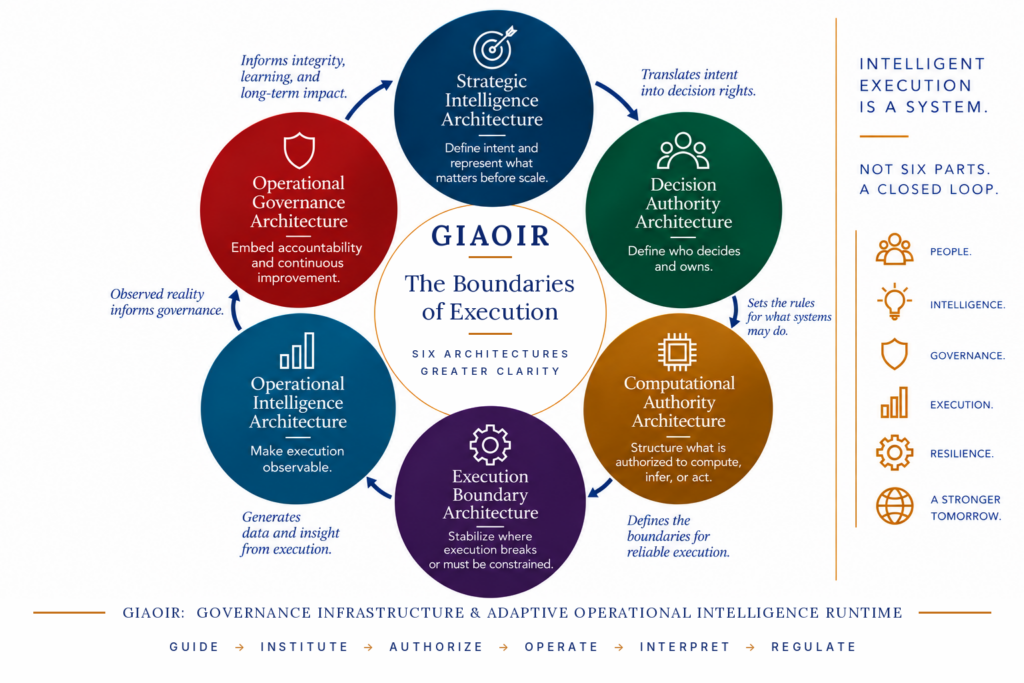
Six architectures. One closed loop. Intelligent execution governed from intent through learning.
The Six Architectures
Each architecture governs a distinct layer of intelligent execution. Together, they are how Tinica Walker Group provides technology consultation in the field of artificial intelligence.
01Strategic Intelligence Architecture™
Define intent and represent what matters before scale.
02Decision Authority Architecture™
Define who decides and owns.
03Computational Authority Architecture™
Structure what is authorized to compute, infer, or act.
04Execution Boundary Architecture™
Stabilize where execution breaks.
05Operational Intelligence Architecture™
Make execution observable.
06Operational Governance Architecture™
Embed accountability as structure.
The Closed Loop
Strategic Intelligence → Decision Authority → Computational Authority → Execution Boundary → Operational Intelligence → Operational Governance → Strategic Intelligence
Intent defines authority. Authority bounds computation. Computation meets the execution boundary. Execution becomes observable. Observation becomes governance, and governance returns to intent. No architecture holds on its own. The loop is the system.
The loop resolves at The Boundaries of Execution: where decisions resolve under pressure, dependencies converge, and human judgment absorbs operational load in real time.
Most organizations govern after instability becomes visible. That is delayed correction, not operational governance.
Execution integrity is designed at the boundary.
As velocity increases, pressure concentrates faster than governance can stabilize. The organizations that remain reliable embed governance into execution before instability compounds. This is not a technology problem. It is an architectural one.
Engage Tinica Walker Group
Begin with the boundary where your execution is under the most pressure.
Outcomes
- Lower systemic risk
- Unambiguous accountability
- Faster, bounded decisions
- Execution that holds under load
- Feedback loops that surface drift before it becomes structural
- Governance that exists inside execution, not downstream of it
Engagement
Engagement is selective and begins with Execution Boundary Alignment: identifying where execution breaks under load, where authority is ambiguous, and which architectures must be designed first. From there, work extends to one architecture, several, or the full loop.
Lens
Operational discipline — DFSS for architecture — DMAIC as operational governance — SMaC: Specific. Methodical. Consistent.
Governance designed into execution.